What designers are saying, Dec 2025 – Nov 2026
Why I counted
When the crash made paintings hard to sell, I went back to Loughborough University and studied social psychology from 2010 to 2013. The method I took from it is the one used here: count what people say, read it in context, and write down the limits before anyone else has to point them out.
I design products for a living, and the tools designers work in are what I want to design next. So I turned that method on a year of popular design podcasts, where designers talk about where those tools are going. The companion piece, A History of Design Tools, covers the sixty years before.
Headline findings
Over 12 months, the talk on popular design podcasts moved from "designers can code now" to "designers direct AI agents". Seven findings came out of 99 episodes and about 965,000 words.
- Agents replaced code as the topic. "Agent" appears in 50% of episodes in Dec–Feb and 89% in Sep–Nov. Mentions of "code" per 100,000 words fell by more than half. "Vibe coding" went from 38% of episodes to 6%.
- The canvas didn't die. Its job changed. "Canvas" rose from 38% of episodes to 83%. People describe it less as where work starts and more as where they shape, compare and review what AI made.
- Figma stayed central, but became one stop on a longer route. It is named in 75–89% of episodes every quarter. Speakers now use it for early direction, then push the work into code through connectors. Most "Figma is dead" claims get pushed back on.
- Designers are writing their know-how down for machines. "Skills" files, design-rule documents and design systems "for agents" keep coming up. MCP, the standard way of plugging tools into AI, went from 8% of episodes to 44%.
- Apps are losing their front door. Some speakers say they never open certain tools any more and use them only through an agent. One guest calls this design tools "going headless": the tool works, but nobody looks at it.
- "Taste" is the word people reach for to name what AI can't do, and it is wearing out. It peaks at 61% of episodes in Jun–Aug, then drops to 22%. Guests define it as judgement, editing or "saying no", and some call the word pretentious.
- Tool names churn within months. Lovable fell from 62% of episodes to 17%. Grok Bot went from zero to 33% in the last quarter. Only Figma and Cursor are named steadily all year.
What I take from it
- Where the work starts is the clearest way to read the history. Each era of design tools can be told by the surface where work begins. This year of talk shows that starting point moving off the canvas and into a prompt during 2026. This is my reading of the data, not something speakers say in so many words.
- Much of this talk is sponsored. Popular design podcasts are often paid for by the AI tools they discuss, and about half of all Framer mentions sit inside sponsor reads. Their conclusions need balancing with sources that are sceptical of AI.
- One year is not enough. It can't tell a new shift from a repeating cycle. Earlier years would show whether "Figma is dead" talk comes and goes in waves, and that is the next thing I'll look at.
The shifts in numbers
The biggest movers are canvas (up 45 points) and Lovable (down 45), followed by agents (up 39) and vibe coding (down 32). Each term is counted only when an episode says it at least twice, so one passing mention doesn't count.
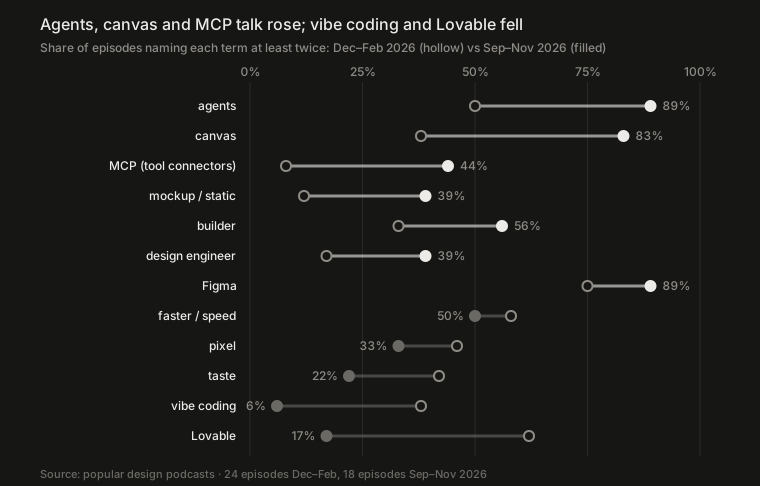
The pattern doesn't come from one or two episodes. No single episode accounts for more than 8% of all "agent" mentions or 13% of "canvas" mentions. Three things the chart can't show:
- Taste rose before it fell. It peaked at 61% of episodes in Jun–Aug, then dropped to 22%.
- New agent tools arrived in the last quarter. Grok Bot appears in 33% of Sep–Nov episodes and none before. Codex and Conductor (apps for running AI coding agents) first show up from the spring onwards.
- The groups are small. Each quarter holds 18–39 episodes, so a change under about 15 points could be noise.
What people say, in their own words
I read 763 passages where speakers described something changing ("used to", "anymore", "a year ago") plus passages around each rising or falling term, then grouped them. Where an episode centres on one guest, quotes carry their name, though a quote may still be the host's. Dates are to the month.
1. The canvas changed job: it's no longer the starting point
The canvas comes up more than ever, but its role has been demoted and redefined. Work now often starts in a prompt or in code. The canvas is where people bring AI output to compare versions, refine it and review it with others.
- "The canvas is no longer the place I start any design work" (Oct 2026). The same speaker calls the canvas the place "I bring in the ball of clay" to shape.
- "I'm very bullish on the canvas", but "I have detached it… from the old way of working" (Oct 2026).
- "We associate a way of working with the canvas that feels outdated" (Nov 2026).
What it means: the old order was draw first, then build. Now it is often build first, then draw on top.
2. Figma moved from home base to a waypoint
Nobody in this year of data seriously says Figma is finished. They describe a narrower job for it: early visual direction, then a hand-off into code, often automatically.
- "Figma is still the appropriate place to… build some visual conviction" (John Bai, Sep 2026).
- "I just transferred it back to code with Figma MCP" (Oct 2026).
- "There was this window of time where it was like a lot of Figma still"… "it's just flipped" (Geoff Teehan, Oct 2026).
- The minority view: "I actually am not in Figma anymore and I'm only doing code prototypes" (Kyle Barber, Oct 2026).
3. Design know-how is being written down for machines
The most distinctive new activity is designers turning their judgement into written instructions that an AI follows: "skills" files, design-rule documents, and design systems built so that agents can read them. Design-system talk per word doubled in the last quarter, though a third of it comes from one long episode.
- At Shopify, rules go into simple text files "so that those skills can then just be deployed" to everyone's agents. The stated goal: "I want everything to just accidentally be amazing" (Derek Briggs, Nov 2026).
- A whole episode was given to design systems for agents (Nov 2026).
What it means: craft is becoming something you package and distribute, not only something you do by hand. For a history of tools, this is new. Earlier tools stored files; these store rules.
4. Apps are being used without being opened
Some speakers now reach their tools only through an AI agent, never through the tool's own screens.
- "I expect to be able to do everything from an agent now"… "I never open Beehive anymore" (Oct 2026). Beehive is an email newsletter tool. The same speaker says the same about Notion and several other daily tools.
- "You shouldn't have to look at the code anymore" (Nov 2026).
- One interview with Tom Krcha is framed around design tools "going headless" (Jun 2026).
What it means: if this spreads, the screen a tool shows people matters less than how well it connects to agents. That's a big change for an industry built on interfaces.
5. "Taste" is the name for what AI can't do, but nobody agrees what it is
When speakers need to say what humans still add, they reach for "taste". Asked to define it, they give different answers.
- "Taste is just saying no" (Jason Yuan, Aug 2026).
- "Discernment is just another word for taste" (Meaghan Choi, Aug 2026).
- "Some people call it taste. I find that a little pretentious" (Ron Goldin, Jul 2026).
What it means: the word carries a lot of weight with little agreed meaning. Its drop to 22% of episodes in the last quarter may mean people are switching to more concrete words like judgement or point of view. That is worth watching.
6. The junior designer's path is the open wound
If AI does first-pass layout and production work, where do beginners learn?
- "Where does the next generation of senior designers come from?" (Apr 2026).
- Hiring leaders say they want "junior people but not the ones who call themselves junior" (Ben Blumenrose, Apr 2026).
- Portfolios are shifting away from foundational work: "Wireframing, responsive layouts… they used to be the whole case study" (Mar 2026).
No one in the data offers a working answer. The question peaked in Mar–May and then faded from view rather than being resolved.
7. Speed stopped being the selling point
Early in the year, AI was sold on speed. Later, speed is assumed and the question becomes what to make.
- The old "trade of speed and quality… doesn't exist anymore. Now it becomes what to build" (Dessn, Feb 2026).
- Mentions of speed per 100,000 words fell from 39 to 17 over the year.
Where the data argues with itself
The sceptical voices are few, but they are there, and they matter because they come from working studios rather than tool makers.
| Claim the talk leans towards | The pushback in the same data |
|---|---|
| AI changes how design gets done | "AI in the design process is just another tool. It hasn't replaced anything" (Myles Palmer, Metalab, Oct 2026) |
| Visual design tools are on their way out | "This isn't the full like Figma is dead… moment, if there ever will be" (Feb 2026) |
| Roles are merging into one "builder" | It "leads to hiring managers thinking that they only need to hire one person" (Danny Martinez, Oct 2026) |
| AI output is "slop" | "I'm making micro decisions that I didn't have a grid for a year ago" (Jun and Oct 2026) |
| Being able to make anything is freeing | "I have experienced the overwhelm of being able to create anything" (May 2026) |
One pattern runs under all of this. Hosts and guests often name the hype themselves and then go on using its vocabulary. One episode puts the split neatly: "One calls it a miracle and the other calls it slop" (May 2026). The middle ground, where AI is useful but ordinary, gets the least airtime. That's probably because it makes the least exciting content, not because few people hold it.
Limits
- Much of the talk is sponsored. About half of all Framer mentions sit inside sponsor reads, so Framer and Paper counts are left out of the findings. Figma, Cursor and Claude Code mentions are nearly all outside sponsor reads.
- One reader, not a team. The themes are one person's grouping, and a second person might group them differently. The quotes are there so you can judge for yourself.
- One year only. That is too short to tell a lasting shift from a passing cycle.